
6 Ways To Get Taken Seriously at Work
This blog is reader-supported. When you purchase something through an affiliate link on this site, I may earn some coffee money. Thanks! Learn more.
When you’re the youngest person in the room, or in the minority in some way, or just new to your role and trying to make the best impression possible, sometimes it feels like you aren’t being taken seriously at work.
I often hear from people who worry about not being considered a serious player in the office. Young women seem to suffer the most – at least, I’m most aware of it affecting that group – but it seems to hit everyone at some point.
Getting taken seriously at the office is something that you can work on. It isn’t always easy to build a sense of gravitas (especially when faced with more senior colleagues) but you can get better at coming across in a way that makes people take you more seriously.
Here are tips from 6 experts to try.
1. Look out for inappropriate behavior
“Identify negative, non-professional behaviors towards you and call them for what they are,” says Vlad Zachary, CEO of CareerConceptZ.com. “Often male colleagues and bosses are not aware and would be willing to change.”
It’s certainly worth pointing out to them when you realize that their behavior is not professional and contributing to keeping you down.
Zachary also suggests learning about the ‘Ritual Conflict’, which is often the intimidating part of the male interactions at the workplace. “See if you can adapt or even use this type of interaction to your advantage,” he says.
In my view, if you call out a behavior and don’t get a positive reaction, then it might be time to change workplaces.
If you want to know how to provide feedback about someone’s behavior or performance, this guide to giving management feedback will help.
2. Always act appropriately
Don’t force other people to say grace with you at work dinners. Don’t answer the phone unless you can spare the time to give the caller your full attention for the duration. Don’t decorate your desk with inappropriate things.
These, and many other bits of advice on how to get taken seriously at work, come from Ann Marie Sabath’s book, Business Etiquette: 101 Ways to Conduct Business With Charm and Savvy.
“Maintain confidentiality,” she says. “Treat your electronic correspondence with the same respect that you do any business letter or memo. Refrain from sharing or forwarding e-mail unless given permission to do so by the original sender.”
Do this, and you’ll find that great relationships with colleagues come easily.
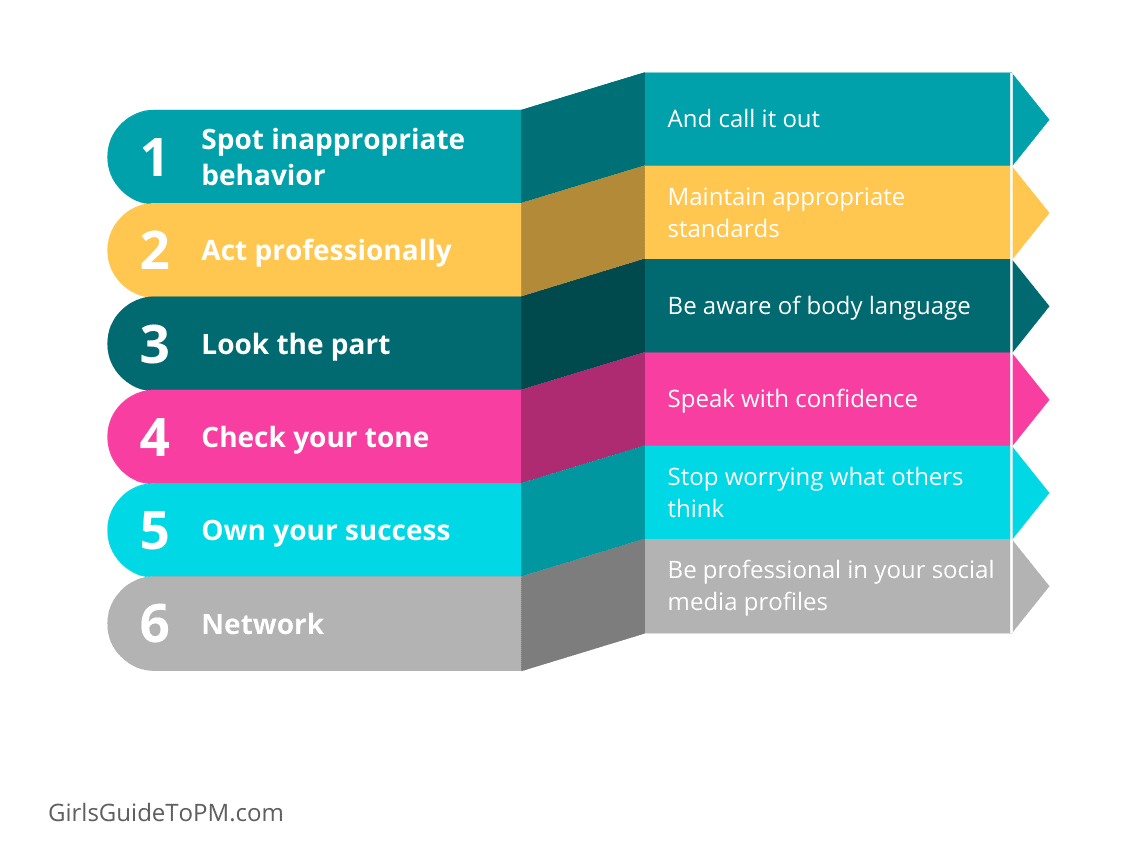
3. Look the part
Looking right for the situation is really important. No one will take you seriously if you turn up to a meeting in a track suit – unless you’re a sports coach.
“Young women need to slow down their walk and talk,” says Debra Benton, an executive coach and author of How to Think Like a CEO.
She also advises keeping your head level, not tilted to one side (something I have difficulty with), and not bobbing along either. But it’s more than just body language – how you dress is also important.
Women should “dress to the level above who they report to,” she says, without letting their dress be more interesting then they are.
Look out for how women at your boss’s level and higher dress and take your cues from them.
Having said that, Kat Griffin from the fab website Corporette was interviewed for Business Insider and she said that advice is out of date. I’m inclined to think that she has a point.
Look at what people above you are wearing and then use your professional judgement and a bit of common sense to see whether that’s something you can copy or not.
This is a great video about the power of body language: it doesn’t just affect how others see you, it changes how you see yourself.
4. Watch what you say… and how you say it
Betty-Ann Heggie, a former senior executive with the world’s largest fertilizer company, has some advice based on her own experience. “Women in management positions need to work much harder than their male counterparts to be taken seriously,” she says.
“Recognizing that women, especially young women, will speak with uncertainty, raising their voices at the end of each sentence, I made sure that I always spoke with conviction, even if unsure,” she says.
“Since research shows that we listen best to those who are most like us, I used a very masculine communication style to project my ideas. I didn’t allow myself to be interrupted and I peppered my language with military words and sports metaphors.”
Oh dear. I really don’t want to have to learn the off-side rule to get myself understood at meetings.
Still, Heggie has a point about using the words that you need to get understood – which usually means toning down your project
5. Stop worrying about what others think
“The typical way to look at women who lack confidence is that it’s due to something peculiar to women: maybe it’s their brains or their hormones, or at least the psychology of being female, that makes them downgrade their own abilities and accomplishments,” says Alice Adams, author of Playing to Strength: Leveraging Gender at Work, and Vice President of Common Ground Diversity Consulting, which focuses on workforce diversity education.
“I think it’s a lot simpler than that, and that anyone, man or woman, who’s assumed to be a lightweight has a harder time getting ahead,” she says.
“Of course that kind of struggle affects confidence level. Qualified women really aren’t taken as seriously as their male colleagues—many studies bear that out—so they’re more likely to have to deal with the emotional fallout of being held back, including a realistic reduction in their confidence about whether they’ll be able to fulfill their ambitions.”
Adams should know about the research; she’s the former Director of Women’s and Gender Studies at the University of Maine Farmington.
It’s not practical to stop being a woman at work, but you can stop beating yourself up about it. You have to learn to come to terms with the perceptions others might have of you and deal with it.
“Many women cope with all that by instituting a practice of regular, rational self-assessments, and giving more weight to that than to the less predictable reactions of colleagues or superiors,” Adams explains. Sounds sensible to me.
Own your success: career progression gives you the option to control your finances and do so much more with your life outside of work as well as making an impact for good in your organization.
6. Network – in a work-related way
“Don’t let your social networks define you at work,” says James Lee, President of the Lee Strategy Group. “Eliminate provocative poses in pictures and cut the pop culture references on your feeds.”
You’ve done that already, right?
Get your privacy settings right too. “Build a work view on your social networks,” Lee advises. “Become activist on non-profit and business-related causes and Fan Pages [on Facebook]. Share links on articles of interest.”
Lee is another one who advises learning the management bonding language of sports. I was once advised to learn how to play golf for networking purposes by a senior manager – and I left that team soon afterwards.
You can find office cultures that don’t rely on you having to know the scores from weekend matches.
Not sure how to network? Grab my ebook on how to do it in real life.
Don’t be crushed by imposter syndrome
Not being taken seriously, combined with the feeling that you really don’t know if you deserve your success (that’s Imposter Syndrome), conspire to make women less successful at work than they really should be.
You’re responsible for overcoming that. The bottom line – in my opinion – is that if you aren’t taken seriously, and you know you are doing all the right things, then that company isn’t for you.
Don’t struggle to change organizational culture on a one-woman crusade. Find somewhere where you can flourish, and where people treat you in the professional way you expect.
Start by building your personal confidence and crushing Imposter Syndrome. My 100+ page ebook will help with the strategies you need to start owning your place at the table.
A version of this article first appeared in 2013.
