The Definitive Guide to Project Success Criteria
This blog is reader-supported. When you purchase something through an affiliate link on this site, I may earn some coffee money. Thanks! Learn more.
I get asked about project success criteria a lot – in fact, it’s one of the most searched terms on this site. So I thought it was about time that I pooled all my resources into one definitive guide to project success criteria.
If you’re looking for how to define success criteria, how to document and measure them and what to do after a project finishes, then read on!
Let’s start with a definition of project success criteria.
How to define success criteria
Project success criteria are the standards by which the project will be judged at the end to decide whether or not it has been successful in the eyes of the stakeholders.
OK, I’m glad we got that sorted. Now let’s look at why we should care about project success criteria.
Why are project success criteria important?
Organizations don’t define failure. We don’t document how we will know if a project has failed – what failure looks like – because thinking about failing is not a good way to motivate the project team when the work has only just started.
The absence of a formal definition of failure makes it uncomfortably easy for internal and external stakeholders to brand projects a failure.
Think about some of the projects that have hit the headlines recently (in any country). Projects ‘fail’ in the eyes of the media and stakeholders because for people are left to guess what success looks like.
Is it delivery on time? Is it delivery on budget? Perhaps those two things really don’t matter much to the stakeholders concerned if they get a great quality result and happy customers, which is pretty much the theme of my book, Customer-Centric Project Management.
Take the guesswork out of success
Successful organizations take the guesswork out of this process: they define what a successful project looks like, so they know when they have achieved it. If you want project success, you have to define what success looks like for your project.
Perhaps the project budget is the most important thing to your stakeholders, and quality is taking a back seat on the project. Perhaps customer satisfaction is essential, and you don’t care how many overtime hours the team has to work to get that end result.
(Side note: you should care about overtime. In the US, workers contribute an average of 233 hours of unpaid overtime to their employer per year, which is the equivalent of working over a month for free. Not something you should be encouraging.)
Project managers can use success criteria as a great tool for stakeholders to generate engagement.
(For more tools for your stakeholder management work, grab this set of stakeholder management templates — everything you need to organize and build successful working relationships with everyone on your team.)
You can use them to define the project’s goals and track progress – and if your stakeholders stop caring about your success criteria you’ve got an early warning sign that you need to do more to continue to keep them on side.
Project success criteria are the standards by which the project will be judged at the end to decide whether or not it has been successful in the eyes of the stakeholders.
Whatever success looks like, you have to define it so you can own it. There are two types of success criteria that you’ll need to define for your project.
Two types of project success criteria
So you want to know how you’ll know if your project has been a success? You need to identify what success looks like for you and your stakeholders. And the easiest way to do this is to brainstorm with your team.
1. Criteria related to project management
During this process you’ll probably come up with success criteria related to the management of the project. These are the success criteria which you can refer to in project audits or the post-project review.
They help focus your mind on the ‘business’ of project management and relate to doing the project right. They help you check that you’re hitting all the right targets and are applying project management standards appropriately.
Examples would be things like:
- Hold a Project Board meeting once a month
- Complete project audits in line with the timetable published by the Project Office
- Ensure all timesheets are completed by the deadlines
- Achieve 95% compliance on project quality reviews.
Alone these success criteria are not sufficient. They help you measure whether you’re doing a good job but not whether you are actually delivering anything useful for your stakeholders.
2. Criteria related to deliverables
Your success criteria analysis should also identify deliverable-based project success criteria which are strongly linked to the business case, project scope and the rationale behind doing the project.
It’s hard to give sensible examples as they are tied so tightly to what your project is delivering but you should aim for things like:
- Achieve rollout of software to all users
- Train 95% of staff within the two week training period
- Improve customer satisfaction by 65% over the first three months
- Gain Center of Excellence accreditation for Marketing department.
You get the picture.
So, to summarize with some examples of project success:
- Project management success criteria: Related to the professional job of running the project e.g. Produce and gain sign off for project initiation document
- Project deliverable success criteria: Related to things delivered as a result of the project e.g. Distribute 6,000 instructional leaflets to households in our target area.
Overall project performance is a blend of both of these types of criteria, and should be based on what stakeholders consider to be the most important factors for the project to hit. Typically, this is related to the project goals as in my experience most business leaders tend to be far more concerned about value and getting something good out of the project than whether you filled in your risk register every month.
Another way to categorize project success criteria (don’t use this)
You’ll often hear stakeholders and other project managers talk about the 4 criteria for project success as being:
- Time
- Cost
- Quality
- Scope
This way of categorizing project success focuses heavily on the discipline of project management (Were we on time? Did we come in on budget?) and not on value.
It’s a very old fashioned and largely discredited way of thinking about what success means, although even I still use the iron triangle of time, cost and quality (the triple constraint) when talking to newbies in project management or introducing the idea of what factors matter with key stakeholders.
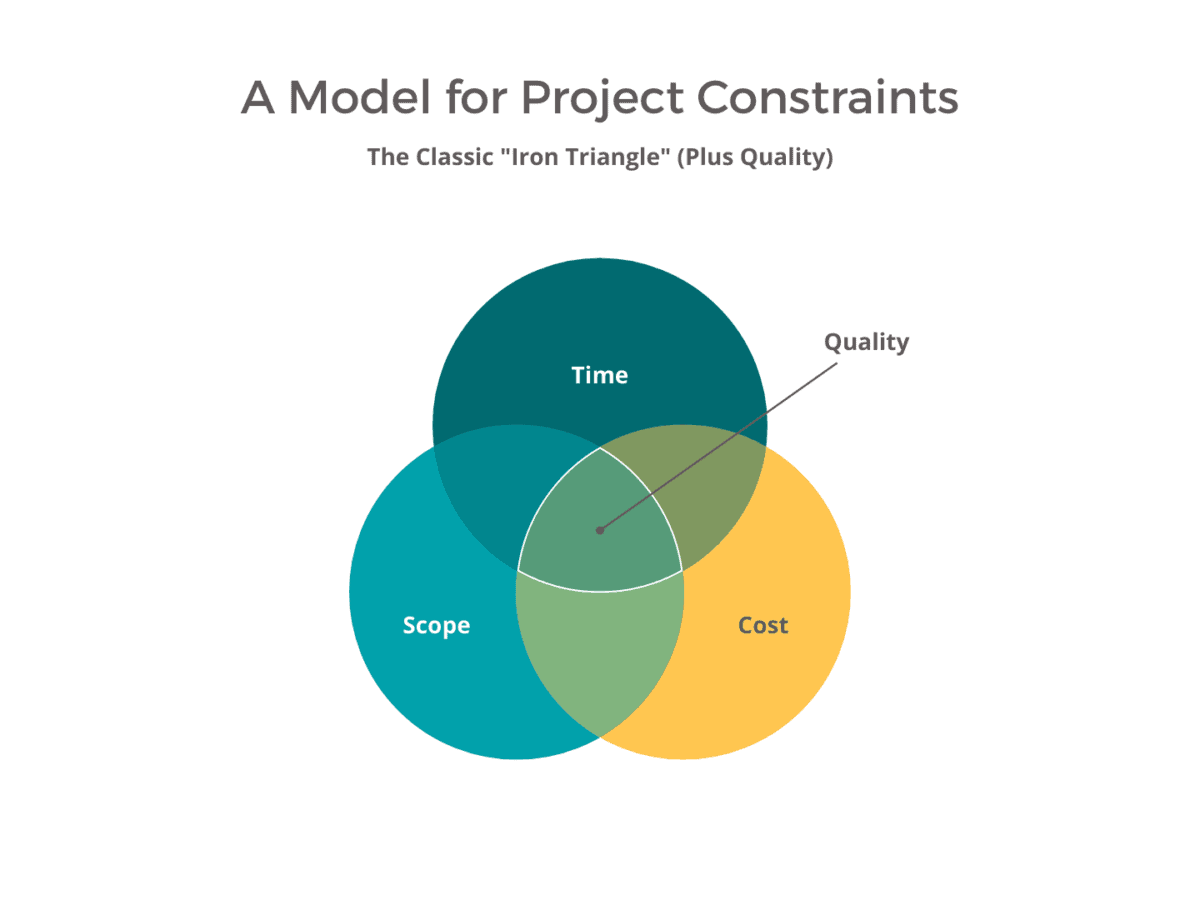
The problem with the 4 criteria is that they aren’t enough. There are other models for project constraints that move on from this and introduce sustainability, customer satisfaction and more but they are models for constraints, not really success.
I’ll let you use your professional judgement about how you want to incorporate the triple constraint into your success criteria but take it from me — it’s definitely not the only thing you want to use to inform your consideration of what good looks like.
How to document your success criteria
Document your project success criteria in a list. I include the list in the Project Charter or Project Initiation Document so it’s easy to refer to (not written one before? This free course on making a project charter is a great starting point).
Each list item should include:
- Name of success criteria
- How it is going to be measured
- How often it is going to be measured
- Who is responsible for measuring it
You can also capture the output of the measurements here if you want, or move that to another relevant project document. Personally I like to keep them separate, but I don’t see why it wouldn’t work to have your records all in one place.
It’s best if this happens during the project planning phase, but it might already be done by then if the criteria dropped out of your business case, for example.
Recording measurement criteria in project management tools
Documenting your success factors in your project management tools or somewhere else where you can easily refer back to them also means that you can get project stakeholders to sign up to them.
Having them clearly recorded makes it easy to refer to them later and there is no ambiguity about what you set out to do. We record ours in the project management software we use. It’s a little clunky, but it means we can easily track and compare projects and measure benefits against a whole program.
Can I change project success criteria later?
Of course, you can change them later, add a few more or take some away if the project evolves. Things always change on projects, so don’t worry about it if that happens.
Just make sure you get agreement from anyone important before you go changing success criteria — remember, what’s important to you might not be the same as what’s important to all your stakeholders!
How to measure project success criteria
You have two choices when it comes to measuring the criteria for success:
- Discrete: Yes/No
We did or did not do something
Examples: Project delivered on time, company gained XYZ accreditation, new branch opened - Continuous: measurable on a scale
We did something to a certain extent, within a target range
Examples: Improve customer satisfaction scores to between 75 per cent and 100 per cent, increase revenue by 8-10 per cent, rebrand 15-20 offices within Quarter Four.
Continuous measurements always include the possibility of being translated into discrete targets. If customer satisfaction was 75 per cent in May, and the target was 60 per cent, you reached the target. If it was 59 per cent, you didn’t.
Monitoring benefits on a continuous scale is always better as it allows you to track changes over a period of time. If the customer satisfaction target was reached in May, that’s fantastic. But you cannot tell from a yes/no measurement if it was better or worse than April or what the trend into June is looking like.
Go for continuous measurements wherever you can. They give you more flexibility and greater options for the future, in case you need them. Basically, the more data you have access to, the better your decision-making can be throughout the project lifecycle.
Baselining performance
It’s great knowing how you are going to measure the criteria for project success going forwards, but how are you doing today?
If you want to capture trending information then you have to take a baseline of current performance as soon as you can, preferably as soon as you have set the success criteria.
The problem is that at the beginning of a project there’s normally so much going on that baselining current performance takes a back seat to doing improvements and delivering change.
Still, make time for it, or you’ll have a harder job later working out whether your project has made a difference, for example to the level of quality or client satisfaction.
It’s great knowing that you are now calling back customers within 20 minutes, but if you don’t know what the call back time was before project was implemented you may very well have made the situation worse – you just can’t tell.
A performance baseline lets you identify the differences in performance in the post-project world related to the things you consider important measures – your project success criteria.
Be consistent
Use the same calculations and tracking method to work out your baseline performance as you intend to do for measuring your success criteria later. Otherwise you are introducing even more variables into the mix – keep it simple.
When do I track success factors?
You’ll take an initial performance benchmark as soon as you can in the project, as we saw above. Then you have to work out how often you want to measure your project success criteria. Put these dates/activities into your project plan.
Each success criteria will have different requirements. Some you can track once a month, others you’ll only measure once more. Some you won’t track very often and then as soon as you hit delivery you might be measuring them daily (like daily quality targets or call handling times).
If you’re in the project execution phase, you might already have some success criteria you can track. Alternatively, your job might be building the mechanism for business users to track success going forward once the project is done.
Tracking project management success criteria
Project management-related success criteria do not need to be tracked over time and so you do not need to generate a baseline of current performance. Once the project or task is over you should be able to say with certainty whether or not, and to what extent, you met the criteria.
Let’s say one criteria for success was whether you held governance meetings regularly. Did you hold those Project Board meetings monthly? I hope so. But if you didn’t, the project is over and, honestly, no one cares anymore.

Tracking success criteria post-project
The true business benefits, on the other hand, hopefully last for a lot longer. Even a one-off project like changing all the office light bulbs to energy efficient ones has durable benefits. The project success factors could be: ‘maintain electricity savings at 40 per cent of previous expenditure for three years.’
The measurement of these over time should be handed to the operations team as part of the project handover when the project closes. You should not keep the responsibility for tracking success criteria (i.e. project benefits) over time.
While the project is running, report on your progress so you celebrate the successes as you go. And if there aren’t successes to celebrate, so you can adjust your project approach so that you do hit your success criteria.
Take a note of what worked with the ‘how’ of measuring success and apply that to future projects.
Project success criteria: the summary
To summarize:
- You must define what success looks like for your project or you won’t know if you have achieved it.
- Success criteria measure what’s important to your stakeholders: think about what stakeholder satisfaction looks like and that should give you a good idea of what they value.
- Document success criteria and get everyone to agree to them.
- Use continuous measurements where possible.
- Baseline today’s performance so you know where you are starting from.
- Track as appropriate and report on your progress.
The next thing
Once you’ve got the success criteria worked out, you’ve got a crucial piece of the puzzle for your stakeholders.
The next thing to consider is how to engage stakeholders throughout the life of the project. You’ll be keeping them informed about progress and you’ll need to create a communication plan to ensure everyone gets the information they require throughout.
